

My Substack subscriptions are discovery filters. I want to read them for things I believe I know less about.
But more than that, I read it for the authors who extract unique insights and choose to share them with the world in their unique style.
At the outset, it seems creative. But creative labor isn’t “creative” at all. It’s laborious. It’s visible, and that labor makes every art, including writing, human.
Until last week, when I felt like hitting a wall reading my favorite writer. She had an 8-minute worth of content, garnished with visuals, markdowns, and AI-backed research.
Fine - even search engines produce AI results. But there’s a format every good research-backed piece follows: Proclamation - Supporting Data - Inferences - Conclusion. And then there is the style (prose) element that pervades them all.
You can add some extra ingredients to your favorite writer profile (“His charts give me under a minute’s read.” or “I keep coming back for her metaphors!”).
But these five are vital ingredients when it comes to your quality social media consumption.
It’s the 2nd item (supporting data) where AI shines. And it’s the inferences and the style that make me follow a writer. I like to form my own conclusions.
What happens when AI infiltrates your writing? It obscures the substance; the AI-produced slope becomes an eyesore.
Yes, that sentence read like AI (the worst kind), just like I intended it to be.
Hello! I am Nirav - a programmer for 20+ years. I solo-published several content-centric apps. When internet businesses were being born, I self-published a nonfiction book.
Brain Bound Learning is focused on linguistics and cognitive science - two branches that have grown in parallel since the invention of modern computers. Our future will increasingly depend on how our brains learn and how we communicate with machines and each other. Brain Bound Learning started in 2023, and I believe it happened at the right time.
While I will try to simplify concepts of these two disciplines, it also means that every article in Brain Bound Learning will try to update a reader’s mental model - even when it is not about any of them. This is a step above declarative AI tutorials that teach you “How to do X by prompting Y”. The full range of ELI-5 to ELI-50 will be available.
AI and LLMs are a huge mental leap for mankind. Brain Bound Learning will try to bridge the skill gap that’s being widened by them every day.
As part of Brain Bound Learning, I also publish free tools for subscribers under the Single Page Sandbox series. I vibe code them to make creators’ lives easier. You are welcome to visit the Single Page Sandbox to access them all. They are:
Completely free
No Signup
Often, runnable offline
Downloadable from TipsNGuts.com
In 2026, this was lazy. Even AI tools know what AI-generated writing looks like. A humanizing rewriting pass would have been all it took.
Brief history of AI writing detectors:
Most initial AI writing happened in academia, for two reasons:
Academic content weighed heavily in GPT tools of the time. Students, with their heaviest writing workloads, were the easiest users to target. GPT makers also needed benchmarks to certify them, which academia easily provided.
Creative, personalized writings on social media were distant use cases that got late attention. Also, genuine authors were less comfortable putting an AI stamp on their originality.
In 2024, even AI users hated AI writing detectors. Students hated them for (often wrongfully) criminalising them. Teachers hated them for snatching their authority.
GPT detectors’ websites were free. They were made with dot-com era HTML. They could get away acting like a boarding school matron, getting paid (in impressions) for giving horrible feedback:
Your human-writing score is 35%. Please go back to your typewriter.
GPT Detectors are now a viable business model:
Nowadays, these tools fly under the radar of the AI power users (Claude, GPT 5.0, Gemini Pro subscribers).
If you are one, you just need (N + 1)th humanizing pass in your paid chatbot that would disinfect your writing from the vector moths. Better, make humanizing part of some skill, and your writing is protected from the AI slope forever.
However, for free users whose profession or education involves heavy writing, AI writing detectors are a boon. Just look at their monthly traffic stats:
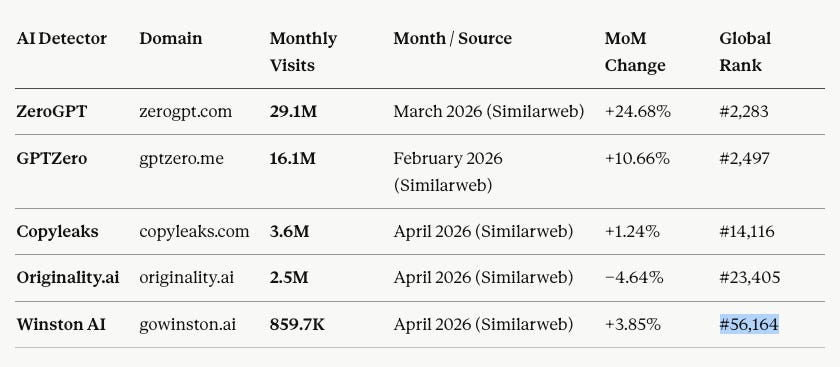
Now, to think that these detectors won’t apply the 2010s speedbraker sprint UX is to be an adult believing Santa Claus is real.
Visit any of them and measure how long/costly it takes to get your text vetted for AI. Consent, Sign up, word limit, payment - Pick your pain points.
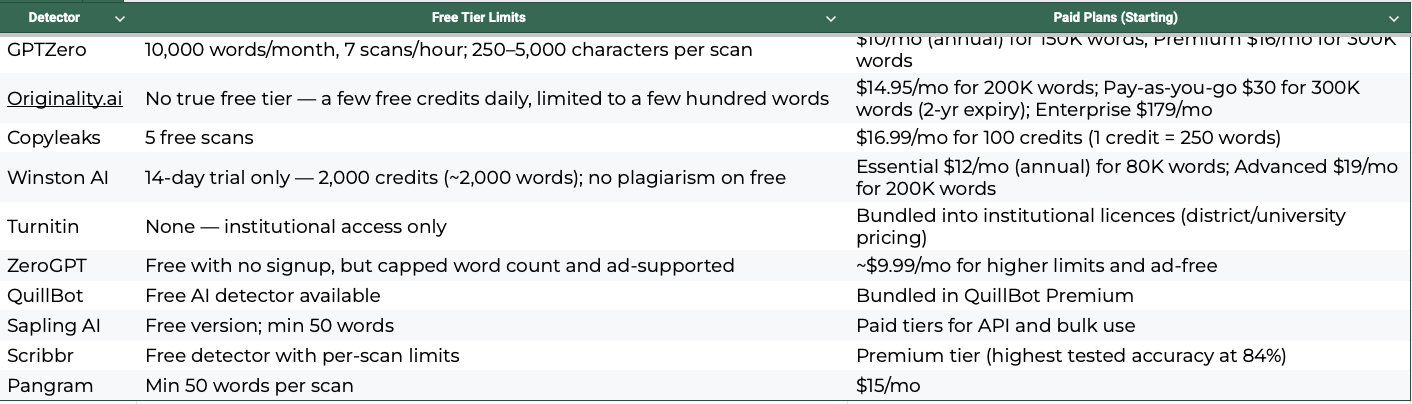
That made me think of having my own AI-detector tool - as part of my evergreen Single Page Sandbox series.
How Does an AI Writing Detector Work?
AI detection is not necessarily a task you delegate to an LLM. Sure, if you ask ChatGPT (or its friends), they can flag and humanize it. But it’s inefficient + token-heavy. If you are on a free tier, context is also a limitation.
To know how, we must go down the history of modern AI, Large language models, linguistics, and how a computer detects human language.
AI-Writing Detection - Statistical Approach:
The most popular way is to use a data-model-based approach. In this, you use a classifier (pretrained data model, such as GPTZero), which contains millions of sentences’ mathematical representations, along with a positive (yes, it’s AI) or a negative (no, it’s human) label.
When your writing input happens to “match” (not word-by-word, but statistically, through embeddings - a word’s “mathematical position” in the universe of meanings, along with other words) one of them, you get a probability score. This scoring process takes place across several dimensions: Perplexity (how often some phrase is used), Burstiness (sentence length), and style (tone).
The cumulative score tells you: This writing is AI, or not-AI.
AI-Writing Detection - Rule-Based Approach:
Another way is to use a rule-based approach that compares certain text patterns to your input using a straightforward computer program and flags your writing.
The tool that I built (link in the end) falls in the latter category (less powerful than the commercial solutions I showed above, but useful in most common cases).
This approach is the precursor to the more powerful (and computationally intensive + model-based) statistical approach. In the AI-writing detection task, though, it began to be used after the model-based approach. In the earliest days of computing, it was a dominant part of natural language processing (NLP).
NLP, as a discipline, is the mother of LLMs that we see today. It was this very thing that got scientists interested in computing in the first place. The primary question, “Can a computer think like a human?” (AGI), got converted into “How can a computer talk like a human?” (Turing Test), which is a defining question of NLP research.
Any LLM operation involves hundreds of NLP tasks that follow this rule-based approach, because the model-based approach is compute-heavy, token-costly, and hence, must be preserved for truly data-intensive, accuracy-focused tasks.
Here’s how LLM engineers stack them:
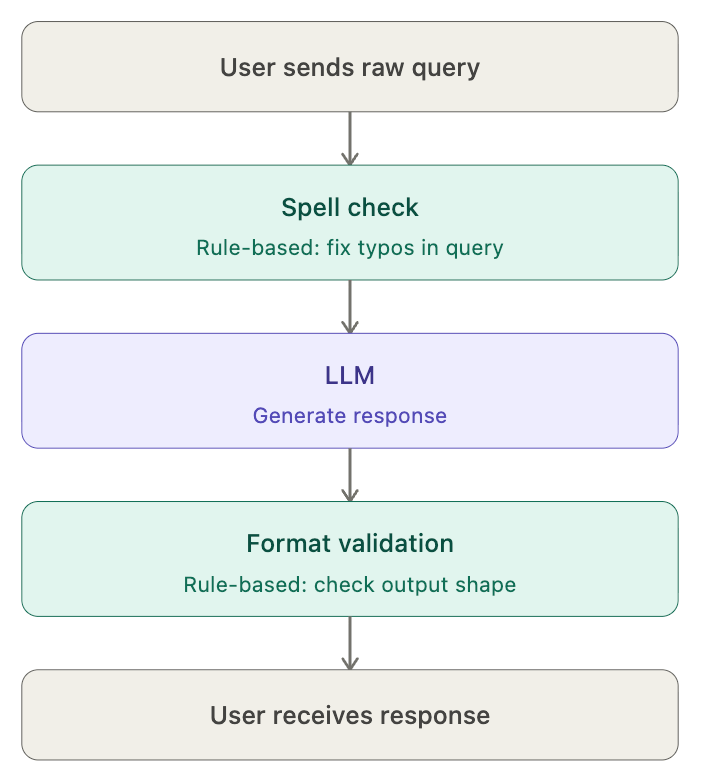
When you query a chatbot, these tools do the heavy lifting of correcting your spelling, fixing your grammar, filling in the missing details, and many other things before passing your sentence. After LLM has fulfilled your intent, they also make it suitable for your consumption via format validation, conversion, and so on.
This keeps a data model for the GPU-intensive task for which it is designed: Statistical word prediction.
How Does the Single-Page Sandbox AI-Writing Detector Work?
The tool I am sharing as part of the Single Page Sandbox series today is an HTML-based minimal AI-detector.
It follows the rule-based detection approach
It is good enough to detect most AI slop
It uses a software concept known as Regular Expressions (Regex). Regex is the pattern-matching engine quietly running behind search bars, form validators, spam filters, and the Find & Replace dialog in every text editor and word processor. When you program, there’s a high chance your code goes through a Regex parser before the compiler flags errors and warnings.
How does a Regex work?
If you want to search for a “cat” or a “dog” in your Word document, you will do a simple “Find” operation.
But what if you wanted to search all occurrences of a “cat” that happens along with a “dog” in the text? You could iterate over the known patterns: “Cat and dog”, “Cat or dog”, and so on. But what about “the cat feared the dog”?
A “Find” operation encoded in a regular expression written as “cat.*dog” will fulfill your purpose, and all text processor programs (text editors, MS Office, IDEs) support it.
Below is my Visual Studio Code experiment wherein I have selected the “Regular Expression” option in the Find window.
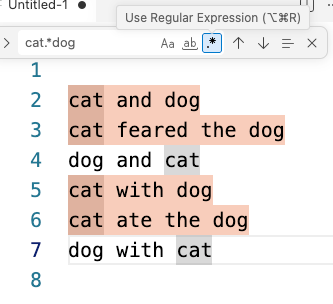
Regex (Regular expressions) are like mathematical equations. When parsed, they evaluate to zero, one, or more strings that match certain, human-desired patterns.
They are highly efficient in expressing a range of pattern intents (e.g., email formats, phone number formats, and so on). However, this brevity comes from the complexity of regex computational engines.
For example, the regex /r[aeiou]+/g can evaluate to all occurrences of the character “r” followed by an arbitrary number of vowels.

/r[aeiou]+/g (Wikipedia)Remember, ChatGPT couldn’t count “r”s in “strawberry”? It’s because it uses a fundamentally different approach (statistical one) than the rule-based regex.
Encoding (creating a regex such as /r[aeiou]+/g) and decoding/parsing regex (finding out that /r[aeiou]+/g stands for vowel series followed by r) requires a tenacious programmer.
In the programming world, a joke goes on like:
“I had a (text pattern search) problem. I decided to use Regex.
Now, I have two problems.”
Before ChatGPT, coders used online tools such as regex101 to get around regex. Today, they mostly (often outside their knowledge) use Agentic tool calls for Regex (Regex MCPs).
Every time you ask Claude to search for bad variable names in your codebase, it fulfills it with a Regex tool call.
What patterns does the local AI-Writing detector detect?
My local AI detector works based on a few regex expressions that flag-
Cliche expressions (Delve into, in the digital age, pave the way, etc.)
Discourse markers (However, Moreover, Furthermore, etc.)
Hedge words (often, generally, typically, etc.)
Negation-Correction (That’s not X. It’s Y.)
Em-dash & semicolon patterns
Then-
It calculates the total occurrences of these successful regex evaluations within the entire text. It then normalizes it across the input (e.g., X sentences out of total N sentences have this pattern)
If the resulting number exceeds a certain threshold (e.g., 40% sentences contain em-dashes), the text is AI-generated for that specific factor.
It repeats this process for 9 different factors that decide AI vs human writing, and produces an average score.
Here’s the demo video:
Download AI-Writing Detector:
Every Single Page Sandbox offering is available on Tipsnguts.com.
Download AI Writing Detector from the link.
Unzip and open index.html.
Input your text (limit: 5000 characters)
Press “Verify AI”, and you get the score. Iterate your input until you get green with a sufficient human score.
It’s free, sign-up free, offline, and forever yours to keep + improve.
Use it to make your writing more human-like, and let me know if you have any words to share in comments!
By becoming a free subscriber to Brain Bound Learning, you get all the newsletters in your inbox + access to every tool published under the Single Page Sandbox series. These tools are safe, free, sign-up-free, and mostly runnable offline.